What's New in Shopify 2026: Fall Edition Breakdown
Shopify's Fall '26 Edition is mostly about AI agents. Here are the three updates to act on before Black Friday, and why Canvas isn't ready for your production theme yet.
Shopify released the Shopify Fall 2026 Edition on 28 October: more than 150 updates under the name "Exponential". Most of them are about AI agents, both the ones your customers use to shop and the ones you use to run the store. Before Black Friday on 27 November, three updates are worth your time: control what AI agents say about your store, schedule your peak-season launch with Rollouts, and set fraud rules before order volume goes up. Canvas and the new Sidekick are the most interesting long-term change, but they aren't ready for stores with a development workflow yet.
Several features are US-only, in early access or marked "coming soon". I've noted availability for each one below.
Shopify Fall 2026 Edition: three things to act on now
What AI agents know about your store
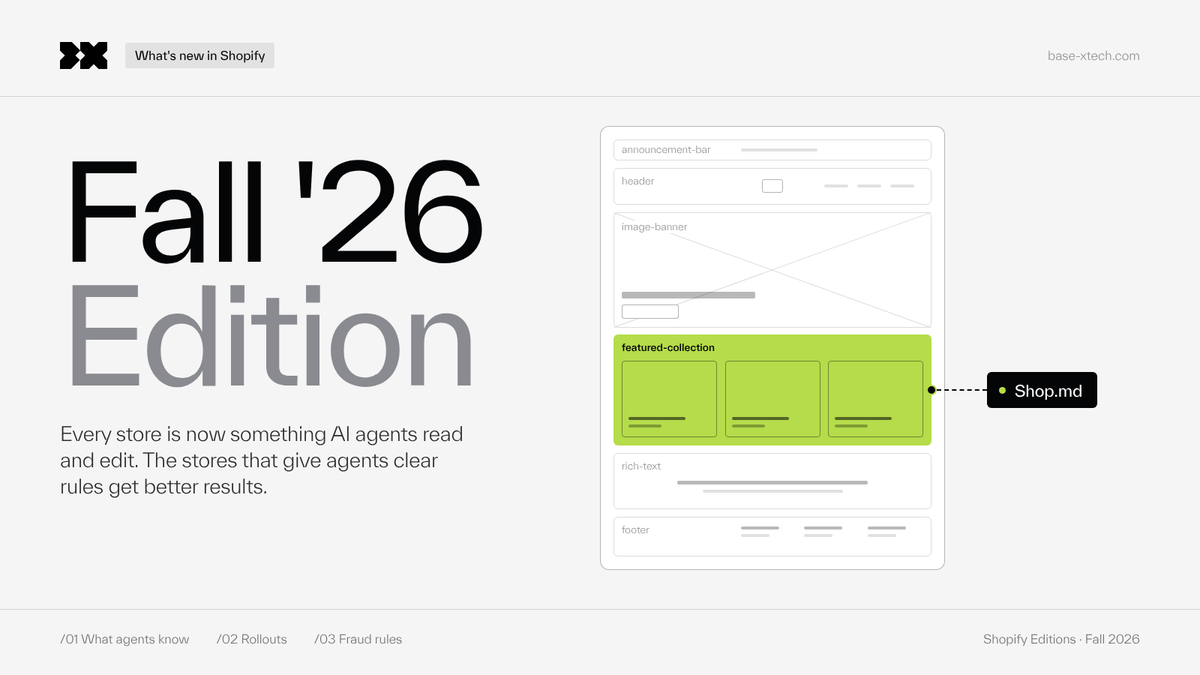
AI agents now read your store and can buy from it. In the US, Shopify-powered checkout inside Google AI Mode, Gemini and Microsoft Copilot is switched on by default for eligible stores. Shoppers can also add Shop.md, a skill that lets ChatGPT, Claude and other agents search more than a billion products and check out with Shop Pay. You don't install Shop.md. The shopper does. What it finds is your catalog and the facts you've published.
The Shopify Fall 2026 Edition gives you three controls over those facts:
- Business details for AI channels. In your admin under Sales channels > Agentic, Shopify drafts your policies, FAQs and store facts from your storefront. Nothing reaches an agent until you approve and publish it. This replaces the standalone Knowledge Base app, which closes on 15 January 2027.
- Catalog eligibility check. It shows whether your store qualifies for Shopify Catalog and what to fix if it doesn't.
- Compare-at prices for agents. Your sale prices are now shared with shopping agents through Catalog, with no setup.
There's a second layer most stores will miss: markdown files. Every Shopify theme now supports two optional files at the theme root, AGENTS.md and DESIGN.md. AGENTS.md explains how the theme is built. DESIGN.md records the design intent: colours, spacing, typography, what not to touch. Sidekick reads both before it changes your theme in Canvas, and coding agents read them as project instructions. Separately, every store has a public /agents.md page for shopping agents. Shopify manages it by default, and a developer can customise it with an agents.md.liquid template.
I'd treat AGENTS.md and DESIGN.md as required from now on, the same way a code repository needs a README. Without them, every agent that touches your theme guesses at your rules, and you clean up after the guesses.
What to do: review and publish your business details, run the eligibility check, and decide whether you want direct checkout on in US AI channels. Then add AGENTS.md and DESIGN.md to your live theme. If you'd like help with the AI-facing side, see our AI search optimisation service.
Rollouts for your Black Friday launch
Rollouts let you bundle a theme, checkout and account pages, discounts and product catalogs into one scheduled change. Fall '26 adds three things that matter in November:
- Catalog scheduling by market, with automatic rollback when the promotion ends. Your Black Friday prices can go live in one market at midnight and revert after Cyber Monday without anyone logging in.
- Discount rollouts, so discounts change at the same moment as the theme and checkout.
- Cross-channel scheduling across headless builds, POS, Google Shopping and the Shop app.
Rollouts work on the Basic plan or higher. Experiments, which test a change against a control, need the Grow plan or higher.
What to do: build your Black Friday launch as a rollout this week and preview it before the date. Keep your main theme out of Canvas until after the peak, because Canvas doesn't support Rollouts yet. Our Q3 to Q4 Black Friday guide covers the rest of the preparation.
Fraud rules before peak volume
Shopify Protect now blocks high-risk checkout attempts before payment is authorised, and the orders page shows which factors raised an order's risk level. For disputes, Protect automatically attaches carrier proof of delivery to "not received" claims and drafts responses based on the bank and the reason code. You can write custom risk rules and backtest them against past orders before switching them on. Some of these features are listed as "rolling out soon" and need the Protect app, so check what's live in your admin.
What to do: turn on what's available and write rules for the fraud patterns you already know about. Backtest them in November, not on Black Friday.
Canvas and Sidekick: the most interesting part, not ready for dev teams yet
Sidekick was rebuilt for the Shopify Fall 2026 Edition. It handles multi-step technical tasks, writes code, searches the web and remembers context. You can approve a plan once and let it apply a batch of changes, such as rewriting descriptions across a collection. It tests proposed store changes in SimGym before recommending them, and now opens from every page of the redesigned admin. Shopify says daily Sidekick sessions grew 4.2x year over year.
Canvas is where this is heading. It shows your whole store in one view, and you edit it by clicking an element or asking Sidekick. It launched on 1 October and is still labelled early access. The direction is the right one: a theme that a merchant, a development team and an agent can all work on, with AGENTS.md and DESIGN.md setting the rules each of them follows. When that works end to end, the gap between "ask for a change" and "the change is live and reviewed" gets much shorter.
Today, a development team runs into hard limits:
- No app blocks or app embeds. Canvas doesn't support theme app extensions yet. Reviews, loyalty widgets and anything else an app places in your theme won't show in a Canvas theme.
- No Rollouts, Markets or translations inside Canvas yet.
- A separate copy. Canvas works on a duplicate of your theme that isn't synced with the original, and themes edited in Canvas don't receive theme updates. Third-party themes from the Theme Store aren't supported yet either.
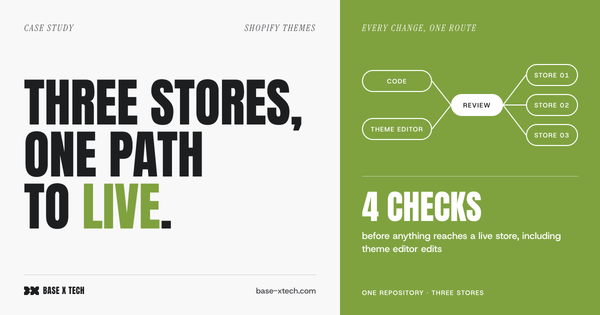
- Outside the review path. If your theme lives in Git with reviewed releases, as in our multi-store theme setup, a Canvas edit sits outside that path today.
Shopify says it will support theme app extensions before Canvas becomes the default editor. Until then, I'd use Canvas for landing pages and new templates on a duplicate theme, and keep the production theme in your code workflow.
Developers also get a preview of a new theme format: templates written in Liquid instead of JSON, blocks with typed parameters, and partials that update one part of a page without re-rendering the section. That matters for the next point.
Our take: headless has fewer reasons to exist after Fall '26
This is an opinion, not a rule. For most brands, the case for headless Shopify got weaker this autumn.
The reasons brands usually give us for going headless are design freedom, a page that updates parts of itself without heavy JavaScript, and a front end their developers enjoy working in. Horizon, Shopify's flagship theme since Summer 2025, already lets you nest and arrange blocks freely and generate new blocks from a text prompt. The new Liquid format adds partials and typed blocks, with Tailwind support announced. And the new AI tooling for themes, Canvas, Sidekick theme editing and DESIGN.md, works on Liquid themes. A headless front end doesn't get Canvas or Sidekick theme editing.
Shopify also rebuilt Hydrogen in the Fall 2026 Edition. It's generally available, works with any framework and comes with an open-source Next.js template. Headless is still the right call if you already run a React or Next.js stack, have a custom CMS tied closely to commerce, or serve several front ends from one catalog. "We need more design flexibility" is no longer one of those reasons. Our headless Shopify guide goes through the full decision.
More in the Shopify Fall 2026 Edition
Script tags stop running on 1 March 2027. Since 1 October 2026, apps can't create or update script tags. Existing ones keep running until 1 March 2027, when Shopify stops injecting them into storefronts. Ask your app vendors now whether they still use them. Older tracking and widget apps are the usual suspects.
Checkout changes. Custom checkout fields for delivery instructions and gift messages, a tiled layout for payment methods, and a shorter stacked form are all rolling out soon. Apple Pay via a QR code for shoppers on other browsers is coming soon. If you customise checkout, see our checkout customisation service.
For European stores. DHL Express labels in Germany, France, Italy, Spain and the UK, and DHL eCommerce labels in the Netherlands and Poland. POS receipts that add EU tax summaries automatically. Return and cancellation rules per market, per-market fees (early access), and translations that stay in sync through Translate & Adapt. The admin is now available in 13 more languages, including Catalan, Estonian, Latvian and Ukrainian.
For US stores. Managed sales tax for newer businesses, tax calculated by fulfilment location, and machine-learning authorisation to raise first-attempt approval rates. HSA and FSA payments through Shop Pay are coming soon.
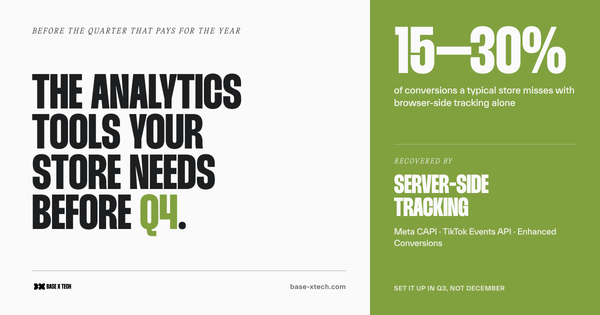
Analytics. Session counts now filter bots and respect consent, so your numbers may shift. You can annotate reports and pull app events, such as loyalty redemptions, into custom reports. Our analytics tools post covers the setup.
What the Shopify Fall 2026 Edition actually means
Shopify is betting that agents become both a sales channel and the main way you operate a store. For your team, that comes down to two jobs. Keep your store data and published facts accurate, because that's what agents read. And keep control of how changes reach the live store: Rollouts now, Canvas once it fits a reviewed workflow.
What I'd skip this quarter: the Grok, Meta Muse and Copilot connectors and the ChatGPT sidebar pin. Try them if you're curious, but don't plan around them. And don't move your main theme into Canvas before Black Friday.
If you're catching up, the Spring 2026 Edition breakdown covers the earlier changes, including the EU withdrawal button and B2B on all plans.
FAQ
What is the Shopify Fall 2026 Edition?
It's Shopify's product release from 28 October 2026, with more than 150 updates under the theme "Exponential". The main changes are selling through AI agents, a rebuilt Sidekick, the Canvas store editor, Rollouts for scheduled launches, and Shopify Protect for fraud.
Which Fall '26 features work outside the US?
Rollouts, AGENTS.md and DESIGN.md, and most Sidekick features aren't limited to the US. Direct checkout inside Google AI Mode, Gemini and Microsoft Copilot is US-only for now, and the AI channel settings are rolling out by region, so check Sales channels > Agentic in your admin. Several payment and checkout features are in early access or "coming soon".
What is Shop.md, and do I need to do anything for it?
Shop.md is a skill that shoppers add to agents like ChatGPT or Claude so they can search Shopify Catalog and pay with Shop Pay. You don't install it. What you control is what it finds: your product data and the business details you publish under Sales channels > Agentic.
Should I start editing my store in Canvas?
Not your production theme yet. Canvas doesn't support app blocks, Rollouts, Markets or translations, and a theme edited in Canvas stops receiving theme updates. Try it on a duplicate theme for landing pages, and add AGENTS.md and DESIGN.md so Sidekick follows your rules.
Does the script tag deprecation affect my store?
It does if any of your apps still inject scripts with script tags. Existing script tags keep running until 1 March 2027 and then stop. Ask your app vendors whether they've moved to theme app extensions or web pixels.
Do I still need headless Shopify?
Probably not, unless you already run a React or Next.js stack, use a custom CMS closely tied to commerce, or serve several front ends. Horizon, the new Liquid theme format and Canvas now cover most of the design flexibility brands used to go headless for.
Base X Tech builds custom Shopify solutions and AI-powered operational tooling. If you want to plan which Fall '26 updates to roll out on your store, contact us.