What's New in Shopify 2026: Spring Edition Breakdown
Shopify Spring '26 dropped 150+ updates. Most of it can wait. A few things — EU withdrawal compliance, the Scripts deprecation on June 30, B2B on all plans — can't. We went through it all and pulled out what needs action now.
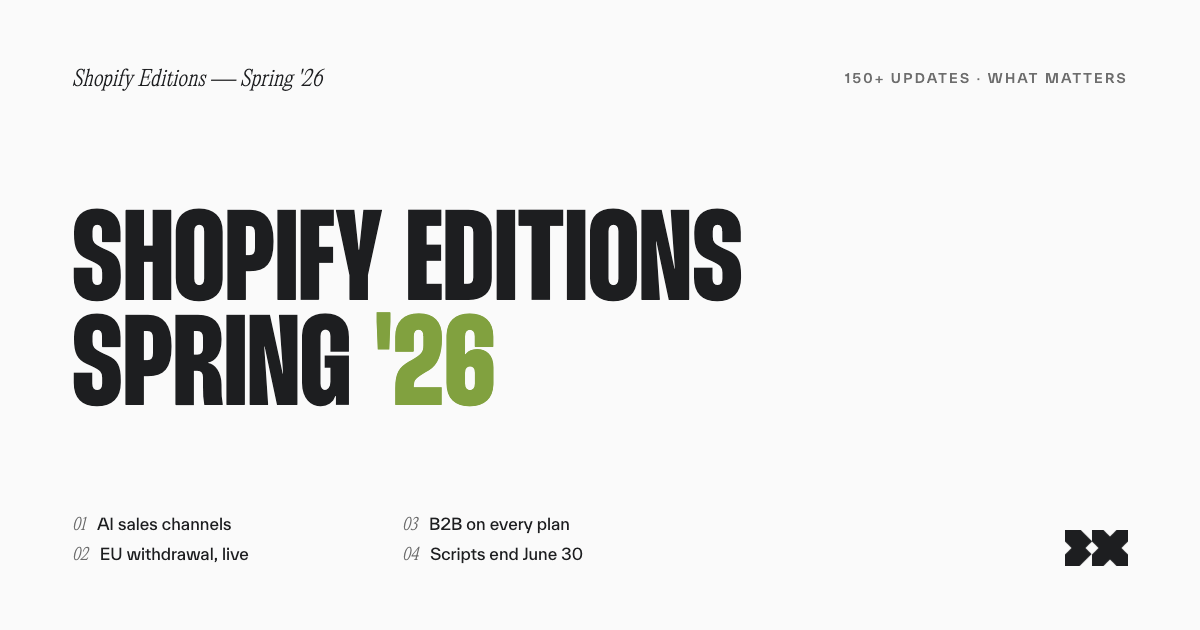
Shopify dropped its Spring '26 Edition on June 17, 2026 — 150+ updates across storefronts, admin, retail, payments, and developer tooling. Most of it you can leave for later. A few things you can't. We went through all of it so you don't have to.
Here's what actually matters and what to do about it.
The three things worth acting on now
1. Your products are now selling inside AI chat — if your data is clean
The headline of this edition is agentic commerce: your Shopify product catalog now syncs automatically into AI surfaces — ChatGPT, Microsoft Copilot, Meta ads — and shoppers can complete purchases through Shop Pay directly in the conversation. No redirect to your store. The transaction happens inside the chat.
The infrastructure behind this is the Universal Commerce Protocol (UCP), an open standard co-developed by Shopify and Google, with Amazon, Meta, Microsoft, Salesforce, Stripe, and others backing it. It covers the full commerce journey from product discovery through checkout. For Shopify merchants, it's enabled by default — you don't need to turn it on.
What you do need to do is make sure it works well.
Enabled and optimised are not the same thing. An AI agent recommending products to a shopper pulls from your Catalog — your product titles, descriptions, attributes, and availability data. If that data is incomplete, inconsistent, or outdated, the agent either walks past your products or recommends them poorly. A product with a vague title and no attributes competes badly against a well-structured one, regardless of how good the actual product is.
The practical task this week: go into your admin's new Agentic section (it now appears in every Shopify admin), check which channels are active, and look at your product data quality. Fix missing descriptions, add proper attribute tagging, and confirm availability is accurate. That's the work that determines whether agentic commerce actually drives revenue for you.
If you want to go further — custom Catalog setup, UCP-ready integration work, or building something on top of the new APIs — that's a custom Shopify integration conversation.
2. EU withdrawal button: live as of June 19, 2026
From June 19, 2026, EU Directive 2023/2673 requires any online store selling to EU consumers to provide an electronic withdrawal function — a two-step form that lets customers cancel a purchase directly from your storefront, without logging in. The confirmation has to go out automatically on a durable medium (email). The button has to be labelled "withdraw from contract here" or an equivalent phrase — "Cancel" doesn't meet the requirement.
This applies to you if you ship to EU customers. Location of your business doesn't change that — a US or UK store shipping to EU buyers is in scope.
The penalty for non-compliance includes an extended withdrawal period: instead of 14 days, the cooling-off period can be stretched to 12 months and 14 days. Some EU member states can also fine up to 4% of annual turnover.
One important nuance Shopify's own documentation confirms: the built-in admin cancel and refund tools don't meet the requirement. Those are merchant-side actions. The directive requires a customer-facing flow. You need either the built-in Shopify withdrawal feature (now live — enable it in your admin), a dedicated app, or a custom implementation.
If you sell into the EU and haven't enabled this yet, it's the first thing to do today.
3. B2B is no longer a Shopify Plus feature
Company profiles, volume pricing, and up to three B2B catalogs are now available on Basic, Grow, and Advanced Shopify plans at no extra cost. Previously this required Plus, which starts at $2,300/month.
If you've been considering adding a wholesale or trade channel and the Plus price was the reason it hadn't happened, that reason is gone.
The practical question is whether your operation is actually ready for B2B — separate pricing tiers, tax handling for business customers, credit terms. Shopify now handles more of the infrastructure. The setup and the business logic still require thought. We've enabled B2B for clients before and can do it now for more — if you're at that decision point, get in touch.
Three more worth your attention
Shopify Scripts stops working June 30, 2026. This one isn't in the Spring '26 Edition feature list — it's a deprecation deadline running alongside it. If your store uses Shopify Scripts for checkout customisation (the old Ruby-based method), those customisations stop working on June 30. The migration path is Shopify Functions. If you're not sure whether you're on Scripts, check your admin now. Checkout logic that breaks silently during a sales period is the worst way to find out.
Sidekick now connects to third-party apps. Klaviyo, Judge.me, and Loop are already live. You can ask Sidekick a question about your Klaviyo data or trigger actions across these apps from a single conversation. This is early — the list of connected apps will grow — but if you're already on any of these platforms, it's worth enabling and testing now rather than later. Campaign Autopilot (AI-managed campaigns across channels) is also in early access.
POS v11 is faster across the board. Retail staff now save over a minute on complex cart builds. The cart stays visible throughout the transaction, with discounts, edits, and customer lookups opening in a side panel. If you run a physical location, the update is worth noting — not because it changes how you operate, but because it reduces the friction points that slow down high-volume checkout periods.
What this edition actually means
Every Shopify Edition has a theme. Spring '26's theme is distribution: your products, structured once, showing up everywhere people are shopping — AI assistants, social channels, in-person, online. The infrastructure for this (Catalog + UCP) is now generally available and on by default.
The stores that get the most out of this edition won't be the ones who spend time reading about it. They'll be the ones who clean up their product data, get the EU compliance sorted, decide whether B2B makes sense for them now, and check whether anything in their checkout is about to break on June 30.
The rest can wait.
FAQ
What is Shopify Editions Spring 2026?
Shopify Editions is Shopify's twice-yearly product release. The Spring 2026 Edition launched on June 17, 2026 with 150+ updates. The main theme is agentic commerce — making Shopify merchants' products discoverable and purchasable inside AI assistants and other surfaces beyond a standard web storefront.
What is the Universal Commerce Protocol (UCP)?
UCP is an open standard co-developed by Shopify and Google that covers the full commerce journey from product discovery through checkout. It's backed by Amazon, Meta, Microsoft, Salesforce, Stripe, and others. For Shopify merchants, it's enabled by default. It's the infrastructure that lets AI agents discover and sell your products across surfaces like ChatGPT and Copilot.
Does the EU withdrawal button apply to my Shopify store?
If you sell to consumers in the EU — regardless of where your business is registered — EU Directive 2023/2673 applies to you. The requirement is live as of June 19, 2026. You need a customer-facing two-step withdrawal form, not just Shopify's built-in merchant-side cancel tools. Enable the native Shopify feature, use a dedicated app, or build a custom implementation.
Do I need Shopify Plus for B2B features now?
No. Company profiles, volume pricing, and up to three B2B catalogs are now available on Basic, Grow, and Advanced plans at no extra cost as of Spring '26.
What happens if I'm still using Shopify Scripts?
Shopify Scripts stops running on June 30, 2026. Any checkout customisations built on Scripts will break after that date. The replacement is Shopify Functions. If you have Scripts in production, migrate before June 30.
Base X Tech helps Shopify merchants with custom integrations, app development, and complex platform work. If any of the Spring '26 updates raise questions about your setup, get in touch.