Why Every Ecommerce Store Needs a Blog (With 4 Examples Worth Copying)
Every so often someone declares the blog dead — meanwhile the best ecommerce brands quietly run blogs pulling in hundreds of thousands of visitors a month. Why an online store should take blogging seriously, plus four store blogs worth learning from.
Every so often, someone declares the blog dead. Social killed it, then video killed it, and now — supposedly — AI has killed it. Meanwhile, some of the most successful ecommerce brands in the world quietly run blogs that bring in hundreds of thousands of visitors a month and rank #1 for the exact terms their customers are searching.
The truth is that a blog is one of the highest-return assets an online store can own — not as a company-news diary, but as an engine for search visibility, customer trust, and sales. This post lays out why an ecommerce business (on Shopify or any other platform) should take blogging seriously, what the benefits actually are, and four real store blogs worth learning from.
Why a blog still matters for ecommerce
Start with the economics, because they're striking. In HubSpot's 2026 State of Marketing report, website, blog, and SEO content is the single highest-ROI channel marketers report — and marketers who prioritise blogging are far more likely to see positive ROI than those who don't. For a store, a blog isn't a cost centre or a vanity project. It's consistently one of the best-performing things you can invest marketing effort in.
But the "why" goes deeper than a single ROI figure. A blog does several distinct jobs at once.
1. SEO: it's how customers find you before they know your name
This is the big one. A product page can only rank for people already searching for your product. A blog lets you rank for the vastly larger audience searching for the problem your product solves — long before they know your brand exists.
Someone isn't always typing "buy beard oil." They're asking "what's the difference between beard oil and beard balm," or "how do I stop my bedsheets overheating," or "what does a deload week mean." Each of those is a question your product ultimately answers — and each is a blog post that can rank, pull in a qualified visitor, and route them toward the thing you sell. 93% of online experiences begin with a search engine, and a blog is how you show up for the informational searches your product pages never could.
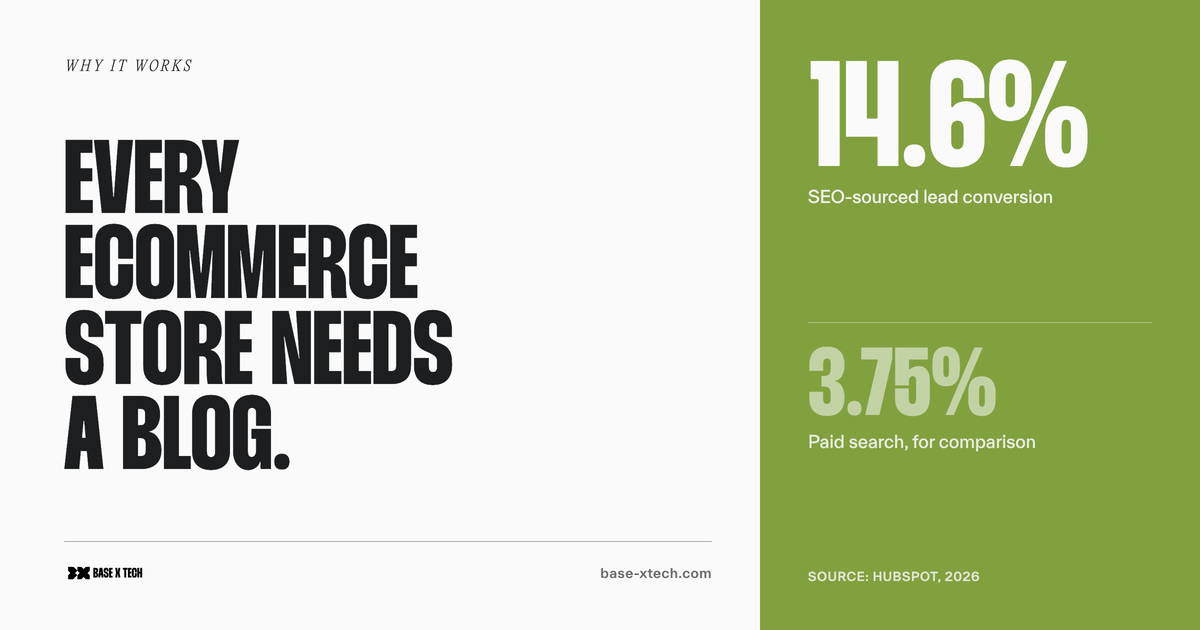
The compounding effect is what makes it powerful. Unlike an ad, which stops the moment you stop paying, a blog post that ranks keeps working for months or years. SEO-sourced leads convert at around 14.6%, versus 3.75% for paid search — organic traffic isn't just cheaper, it converts better, because the reader came looking for an answer rather than being interrupted by an ad.
2. Authority and trust: showing your expertise
People buy from brands they trust, and content is how you earn that trust before a customer has spent a cent. A store that publishes genuinely useful, expert content on its subject signals that it knows its subject — which is exactly what a considered buyer is looking for.
This matters most for higher-consideration purchases. If you sell skincare, mattresses, supplements, or anything a customer researches before buying, the brand that answers their questions honestly and well is the brand that earns the sale. Providing valuable information positions a brand as an industry leader and builds the trust that moves buyers through the funnel. A blog is the most scalable way to demonstrate expertise at the exact moment a customer is deciding whether to believe you.
3. It feeds every other channel
A blog isn't a silo — it's a content engine that supplies the rest of your marketing. One well-researched post becomes newsletter material, social posts, a video script, answers for your support team, and talking points for your product pages. Repurposing content across channels has been found to increase its ROI substantially precisely because the expensive part — the thinking and research — is done once and reused everywhere.
For a small team, this is the difference between scrambling for something to post and having a steady well of substance to draw from. The blog is where the deep work lives; everything else is distribution.
4. It supports the sale directly
Good ecommerce content doesn't just attract traffic — it moves people toward buying. A buying guide that helps someone choose between three options, a comparison that resolves a hesitation, a "how to use it" post that removes a doubt: each of these does sales work that a product page alone can't. Engaging content guides potential customers through the funnel and raises conversion, and it keeps existing customers engaged after purchase, which supports repeat business. The blog isn't only top-of-funnel; done well, it touches every stage.
5. It's increasingly how AI recommends you
Here's the newest reason, and the one that quietly reverses the "AI killed the blog" claim. When someone asks ChatGPT, Perplexity, or Google's AI Overviews for a recommendation, those systems synthesise their answers from web content — and they lean heavily on informational, well-structured writing. One analysis found that a large majority of AI citations are sourced from blog posts.
In other words, the blog didn't die when AI search arrived — it became the raw material AI search runs on. A store with a strong blog isn't just ranking in Google; it's building the content that gets it cited and recommended inside AI answers, exactly where a growing share of product research now begins. Stores with no informational content are simply invisible to that channel.
This shift has a name — answer engine optimization (AEO) — and it's worth understanding, because it changes what "good content" looks like. The goal is no longer only a blue link on a results page; it's a named mention inside the AI-generated answer. Gartner has projected that traditional search volume could drop by around 25% by 2026 as AI interfaces absorb queries, and Google's AI Overviews already appear on a large share of searches. If a buyer forms a preference inside a chat interface before they ever reach a results page, being absent from that answer is the new version of being on page two of Google.
The useful part for store owners is that the content which earns AI citations is the same content that's good for readers — just structured deliberately. Across the AEO research, a few signals come up repeatedly:
- Answer the question directly, near the top. AI engines favour content that leads with a clear, self-contained answer and then supports it, rather than burying the point under 400 words of preamble.
- Use a genuine FAQ section. Questions phrased exactly as someone would type them into ChatGPT, with concise factual answers, are among the most-cited structures — which is part of why every post on this blog ends with one.
- Keep it fresh and credible. Content updated within the last year is cited far more often than stale pages, and AI engines lean toward sources that are well-cited and authoritative. Strong traditional SEO doesn't compete with AEO; it accelerates it.
None of that requires abandoning how you already write. It's the same expertise, organised so both a human and a machine can extract the answer quickly.
Four ecommerce blogs worth learning from
Theory is one thing; proof is better. Here are four real Shopify and Shopify Plus stores running blogs that genuinely drive their business — across four very different niches.
Beardbrand — the content-first grooming brand
Beardbrand is the canonical example, because it did it backwards: it started as a blog — Urban Beardsman — and then built a product business on top of the audience. Content is still central. The blog holds over a thousand articles organised into clear categories, and it ranks #1 in Google for revenue-driving informational queries like "beard oil vs. beard balm" and "stages of beard growth." Independent analyses have attributed roughly a third of the site's total traffic to the blog, with the large majority of the site's traffic coming from organic search.
The lesson: Beardbrand's blog is deliberately plain in design, yet it dominates its niche — because the content strategy underneath is disciplined. Every post is written for a precisely defined reader (the "urban beardsman") and subtly routes toward products. Authority plus intent beats visual polish.
Gymshark — the search funnel at scale
Gymshark Central, the blog of the Shopify Plus fitness-apparel giant, is the clearest example of blog-as-search-funnel. It's a content machine of hundreds of posts, each targeting a specific fitness query — "best bicep exercises," "what is a deload week" — with step-by-step, illustrated guides that then link through to relevant product collections. Backlinko reports the Gymshark blog ranks for over 174,000 keywords and brings in hundreds of thousands of visitors a month.
The lesson: treat the blog as a system, not a scrapbook. Map posts to the exact questions your buyer asks on the way to a purchase, answer each one thoroughly, and link every post to the product it naturally leads to.
Gisou — content mapped to international growth
Gisou, an influencer-founded, Shopify Plus haircare brand, shows what disciplined content can do for a newer store expanding into new markets. By building content clusters mapped to search intent and connecting them to product and collection pages, the brand turned organic search from a passive channel into a consistent acquisition driver — reporting dramatic global organic-traffic growth after launch, particularly in markets where it previously had little non-branded visibility.
The lesson: for a brand that started with social buzz but thin search presence, a structured blog is how you convert fame into findability — and reach customers who've never heard of you.
Slam Jam — culture-led editorial that makes you feel the brand
A personal favourite. Slam Jam, the Italian streetwear institution, shows what happens when editorial content is treated as an extension of the culture rather than a product announcement. Take its piece on the Y-3 × Mercedes-AMG Petronas F1 collection: instead of listing features, it stages the drop through an art film with choreographer Michele Rizzo — a "dialogue between human and machine," club-culture movement rehearsed like the precision of a racetrack, scored with real F1 engine sounds. You come away understanding the collection and feeling the brand's world, and the products are right there when you're ready.
The lesson: content can sell by osmosis. Not every post needs to be a keyword-targeted buying guide — a single well-made article that nails aesthetic, information, and the feel of a subculture can do more for a brand than a dozen generic ones. It's the clearest reminder that a blog is also where a brand's voice lives, not just its SEO.
The common thread
Look across all four and a shared playbook emerges, regardless of niche or design:
- They write for the reader, not about themselves. Whether it's search-intent content (Beardbrand, Gymshark) or culture-led editorial (Slam Jam), the content serves the audience — it's never company news.
- They connect content to product. Sometimes through direct internal links and "shop the product" modules, sometimes by making you want the world the piece describes — but the path from reading to buying is always there.
- They pick a narrow audience and own it. Niche authority and a distinct voice beat broad, shallow reach every time.
- They treat the blog as infrastructure. It's surfaced in site navigation, maintained consistently, and engineered with intent — not left to rot as an afterthought.
None of this depends on being a huge brand. The same principles work for a store publishing its first ten posts — the brands above just show where the road leads.
Why most ecommerce blogs fail
For balance, it's worth being honest: most store blogs don't work. Not because blogging doesn't work, but because of a handful of predictable mistakes. If you're going to invest in content, these are the ways that investment gets wasted:
- Treating it as company news. "We're exhibiting at a trade show," "meet our new team member," "happy holidays from our team." Nobody searches for this, so it ranks for nothing and attracts no one. The blog becomes a diary instead of a funnel.
- Writing for no particular search. Posts that aren't built around a real question people actually type into Google or ChatGPT can't rank, because there's no query for them to rank for. Content without search intent is content nobody finds.
- Never linking to products. A post that attracts a reader but gives them no path to your catalogue is a dead end. The strong examples above all connect posts to product and collection pages — that internal link is what turns a reader into a shopper and passes SEO authority to your commercial pages.
- Publishing three posts and stopping. SEO compounds over time; it doesn't reward a burst of effort followed by silence. A blog abandoned after launch is one of the most common patterns we see, and it never gets the chance to build authority.
- Chasing traffic with no commercial relevance. Ranking for a viral topic unrelated to what you sell brings visitors who never buy. Volume isn't the goal — qualified volume is. A thousand readers with the right intent beat a hundred thousand with none.
- Thin, AI-spun filler. Publishing large volumes of generic, undifferentiated content — increasingly, machine-generated at scale — is worse than publishing nothing. It doesn't rank, it doesn't earn AI citations (which favour credible, authoritative sources), and it can actively erode trust in your domain. Depth and expertise are the point; word count isn't.
The pattern behind all six is the same: a blog fails when it's treated as an obligation to fill rather than a channel to engineer. Avoid these, and you're already ahead of most stores.
How to actually start
If you're convinced and wondering where to begin, here's the shape of a content approach that works — the same one underneath the examples above.
Start with your customers' questions, not your product features. List every question a customer asks before, during, and after buying from you — the ones your support team fields daily, the ones people ask in your DMs, the "how do I choose," "is X better than Y," "how do I use," "how do I care for" questions. Each is a potential post with built-in search intent. This is your topic list, and it comes from your customers, not a keyword tool alone.
Group topics into clusters, not one-offs. Rather than scattered posts, build clusters around a theme — a set of related articles that link to each other and to a central product or collection. Search engines and AI answer engines reward topical authority: covering a subject thoroughly signals you're a real authority on it, not a store that wrote one post and moved on.
Structure each post to be found and to convert. A headline that matches how people actually search; a clear, direct answer near the top (which serves both skim-readers and AI engines); genuinely useful depth in the body; and at least one natural link to the product or collection the post leads toward. End with a short FAQ of related questions — good for readers, and among the most-cited structures in AI search.
Publish consistently, then keep it fresh. A steady cadence you can actually sustain beats a heroic burst that fizzles. And because freshness is now a ranking and citation signal, periodically updating your best posts is often higher-return than constantly chasing new ones.
Mind the technical foundations. Clean URLs, editable meta titles and descriptions, fast page loads, image alt text, and structured data all determine whether search engines and AI can read and trust your content. This is where the platform and the build matter — and where a lot of otherwise-good content quietly underperforms.
You don't need to do all of this at once. A store that picks ten real customer questions, answers each one genuinely well, links each to the right product, and keeps going will outperform the vast majority of ecommerce blogs — which, as above, mostly don't do the basics.
Getting it right on Shopify
If you're on Shopify, you already have a blog built in — Shopify includes native blogging on every plan. It's capable enough for the fundamentals: posts, categories via tags, and the SEO basics like editable meta titles, descriptions, and clean URLs.
What separates a blog that works from one that just exists isn't the platform — it's the strategy and the execution: choosing the right topics, structuring posts to rank, linking them into your catalogue, and keeping the technical SEO clean so search engines (and AI answer engines) can read and trust your content. That's the difference between a blog that sits there and a blog that compounds into a genuine acquisition channel like the four above.
At Base X Tech, we help Shopify brands build content and the technical foundations that make it perform — from blog architecture and SEO to the custom integrations that connect content to commerce. If you want your store's blog to earn its place rather than gather dust, get in touch.
FAQ
Does a blog actually help an ecommerce store, or is it a waste of time?
It genuinely helps — when it's run as a strategic channel rather than a company-news feed. In HubSpot's 2026 research, website/blog/SEO content is the highest-ROI marketing channel marketers report, and SEO-sourced leads convert far better than paid search. A blog lets a store rank for the informational questions its buyers search before they're ready to purchase, builds the expertise and trust that move considered buyers, feeds every other marketing channel, and increasingly supplies the content AI search engines cite. The waste-of-time version is the one with no strategy behind it.
What should an ecommerce blog write about?
The questions your customers ask on the way to a purchase — not announcements about your company. Think buying guides, comparisons, how-to content, and education around the problem your product solves ("how to choose X," "X vs Y," "how to use X"). The strongest ecommerce blogs map each post to a specific search query with clear buyer intent, then link that post to the relevant product or collection so an informed reader can act.
How does a blog help SEO for an online store?
Product and collection pages can only rank for people already searching for your products. A blog lets you rank for the far larger audience searching for the problems, questions, and topics around your products — informational searches your commercial pages can't target. Those posts attract qualified visitors, earn backlinks and authority, and (through internal linking) pass that authority to your product pages. Around 93% of online experiences start with a search engine, and a blog is how you appear for the searches that happen before someone knows your brand.
Is blogging still worth it now that people use AI search?
More than ever. AI search engines like ChatGPT, Perplexity, and Google's AI Overviews build their answers from web content, and analyses show a large share of AI citations come from blog posts. A store with strong informational content isn't just ranking in traditional search — it's supplying the material that gets it recommended inside AI answers, which is exactly where a growing share of product research now starts. Stores with no such content don't appear in that channel at all.
Can I run a good blog on Shopify's built-in blogging tools?
Yes for the fundamentals — Shopify includes native blogging on every plan, with support for posts, tagging, and core SEO fields like meta titles, descriptions, and clean URLs. What determines whether the blog performs is the strategy and execution on top of it: topic selection, post structure, internal linking to your catalogue, and clean technical SEO. Some content-heavy brands extend or customise their setup, but most stores can build a genuinely effective blog on Shopify's native tools with the right approach.
Base X Tech is a custom Shopify agency. We help brands turn their store's blog into a real acquisition channel — strategy, SEO, and the technical foundations that make content perform. If you're planning to take content seriously, get in touch.