Custom Shopify Integrations: A UK Gifting Brand Rebuild
A UK gifting brand with 13 years of history needed more than a new storefront. Every order triggers custom production, there's no fallback, and the whole operation had to be rebuilt. Here's how we connected configurator, ERP, and fulfilment through custom Shopify integrations.
Most Shopify projects are about the storefront. This one was about everything behind it. The store was the last thing we built, and the simplest part of the job.
This case study covers custom Shopify integrations, legacy platform migration, and custom app development for a UK gifting brand operating at scale. If you're looking at what complex Shopify Plus projects actually involve, this is a detailed account of one.
The client and the problem
A UK-based gifting brand with 13 years of history came to us with a platform problem. Their original system was a monolith, built in a different language, grown layer by layer over more than a decade. It worked, but every new feature was a negotiation with a decade of accumulated decisions. Slow to change, expensive to maintain, and increasingly unable to support the operational complexity the business had grown into.
They made the call most brands wait too long to make: rebuild from scratch and move the eCommerce layer to Shopify Plus.
The storefront, it turned out, was the straightforward part. What made this project genuinely difficult was the integration layer: three systems that had to talk to each other in real time, reliably, on every single order. Because in this business, every order is unique. There is no fallback.
Why custom Shopify integrations get complex fast
The gifting model creates an operational problem that standard Shopify isn't designed to solve.
Every order placed through the store is a custom product. The customer configures it, choosing from an asset library, applying personalisation logic, building something that doesn't exist as a pre-made SKU. That configuration has to become a real, manufacturable, shippable item. Automatically. Without anyone in the middle translating the customer's choices into production instructions.
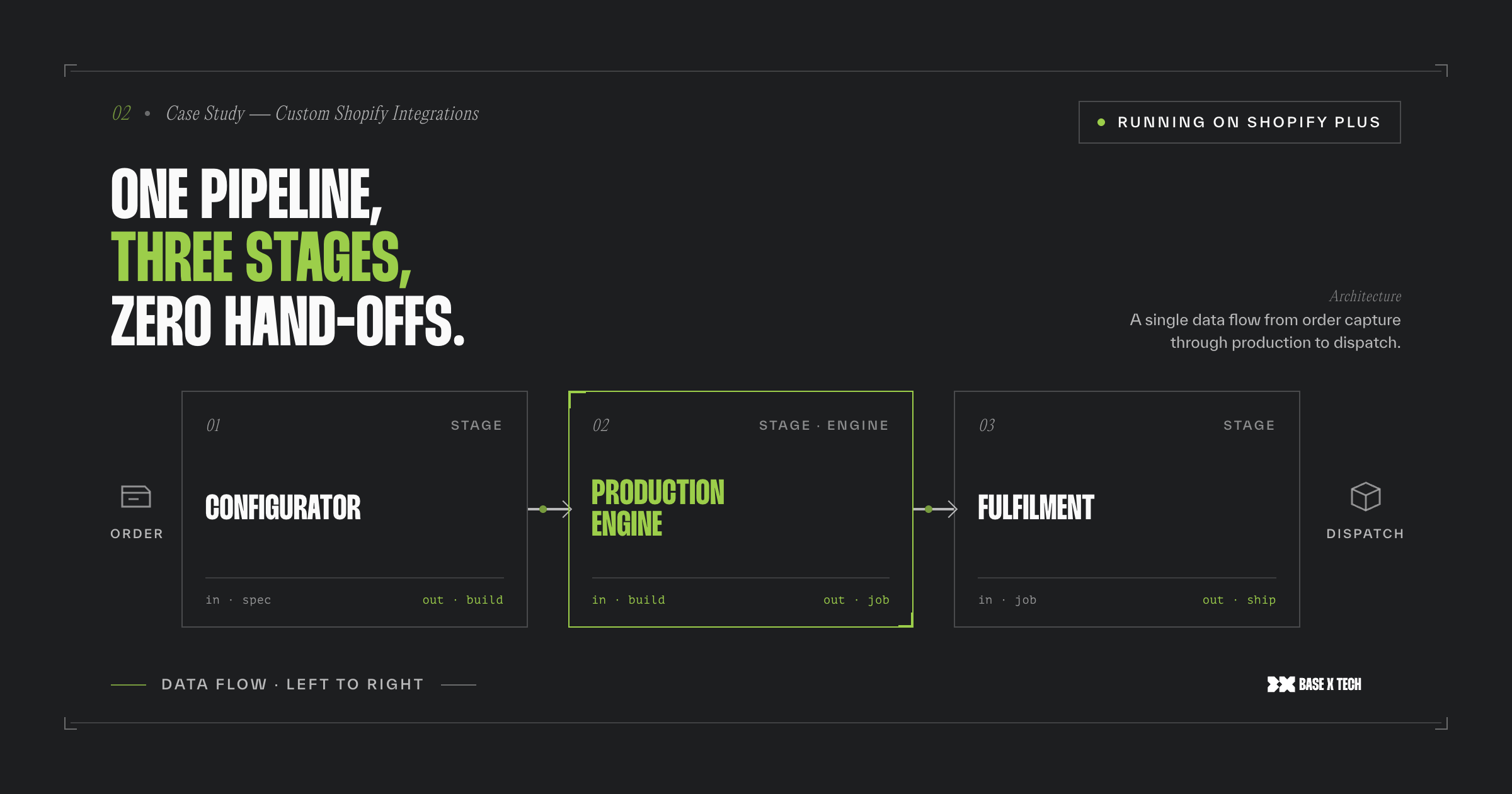
That chain, from configuration to production to fulfilment, runs across three systems. Each one has its own logic, its own data format, its own failure modes. Stitching them together so that a customer's order flows through without manual intervention at any step is where the real engineering work lives.
Getting this wrong doesn't mean a delayed order. It means a wrong order: a personalised product that can't be fixed after it's been printed.
What we built
The configurator. The customer-facing experience is a fully custom gift configurator with its own asset library and personalisation logic. Every configuration a customer builds is unique. Each one is converted into a structured order and pushed into Shopify Plus in real time. Standard Shopify variant logic doesn't accommodate this, so we built the entire layer from scratch as a private custom Shopify app. It doesn't exist in the App Store because no off-the-shelf app handles per-order asset configuration at this level.
The production integration. Once an order lands in Shopify, the production engine takes over. Each order is automatically converted into a print-ready PDF. The system batches orders intelligently to reduce paper waste, then routes them into the production queue. No manual file preparation. No ops team translating customer data into print specs.
The fulfilment integration. The production engine hands off directly to the shipping layer. Shipping codes are generated automatically, courier sync happens in real time, and pickups are scheduled twice daily. In the warehouse, operators scan a barcode on each finished item, and the system routes it to the correct destination without a human making that decision.
Migrating 13 years of customer data to Shopify. The brand had 13 years of customer history on the legacy platform, more than a million profiles. That data had to move to Shopify cleanly, with order history intact and accounts accessible from day one. A Shopify migration at this scale isn't a data export. It's a mapping exercise: understanding how the old system stored customer data, how Shopify expects to receive it, and how to handle the edge cases (duplicate records, incomplete profiles, legacy fields with no Shopify equivalent) without losing records or breaking the post-migration customer experience.
The result: three systems (configurator, production engine, shipping logic) operating as one, built on top of a complete customer dataset migrated from 13 years of history. Every order moves from customer input to warehouse dispatch without a manual step.
What made these custom Shopify integrations the hardest part
Shopify Plus is well-suited to complex commerce. But connecting it to a custom production and fulfilment operation (one with no standard middleware, no off-the-shelf connector, and no tolerance for order errors) is a different class of problem from a standard ERP integration.
The production system has its own data model. The courier integration has its own requirements. The configurator produces outputs that neither system was originally designed to receive. Mapping all three to work together in real time, without a human in the loop, required building the integration layer from the ground up.
This is where the 4 to 6 month timeline came from. Not the Shopify build, which was a fraction of the project. The time was in the integration design: understanding how the existing operation worked, mapping every data flow, building the connectors, and testing against real order scenarios before a single live order touched the system.
We've worked on a lot of Shopify projects. The ones that run long aren't usually held up by the development. They're held up by the discovery: understanding how the business actually operates before you touch a line of code. On a project like this, that discovery isn't optional. If you misunderstand how production batching works, or when courier sync needs to trigger, you find out when a live order goes wrong. That's not a recoverable situation when the product is personalised and already printed.
What Shopify Plus adds to a project like this
Standard Shopify handles the configurator and checkout cleanly. Shopify Plus adds what an operation at this scale actually needs: higher API rate limits for real-time system sync, custom checkout logic for complex order structures, and the infrastructure stability to run a multi-system integration under production volume.
For a business where every order triggers downstream operations in real time, API rate limits aren't a technical footnote. They're a throughput constraint, and Shopify Plus removes that ceiling.
What this kind of project actually requires
Projects like this one are rare on the agency side, but the pattern is consistent. A brand has outgrown its legacy platform. The storefront is the visible problem. The real problem is the operation behind it (production logic, fulfilment systems, warehouse workflows) that has to be rebuilt alongside it.
I've watched brands spend months scoping the storefront and treat the integration layer as an afterthought. It's backwards. The storefront is the part most competent teams can build. The operation behind it is where these projects succeed or fail.
Most Shopify agencies build great storefronts. The harder capability is understanding the operation deeply enough to rebuild the systems that support it, then connecting them to Shopify, through custom Shopify integrations, in a way that holds under real volume.
That's not a development problem. It's an architecture and integration problem that requires development to solve.
If you're running a custom operation on legacy infrastructure, or building something where standard Shopify plus an app stack won't cover the requirements, that's the conversation worth having before you scope the project.
Frequently asked questions
What are custom Shopify integrations and when do you need one?
Custom Shopify integrations are purpose-built connectors between Shopify and external systems (production tools, ERPs, warehouse management platforms, or fulfilment engines) where off-the-shelf apps don't fit the operational logic. You need one when your business runs workflows that no app in the Shopify App Store was designed for: custom order routing, real-time sync with proprietary systems, or automated production triggers that depend on per-order data.
What is a custom Shopify ERP integration?
A custom Shopify ERP integration connects Shopify's order and product data to an external system (such as a production management tool, warehouse system, or fulfilment platform) through a purpose-built integration layer. Unlike off-the-shelf connectors, a custom integration is designed around the specific data model and operational logic of the business, rather than a generic schema.
When does a Shopify project need a custom ERP integration rather than an app?
When the business logic in the external system doesn't map cleanly to standard Shopify data structures, or when the operational requirements (real-time sync, custom order routing, automated production triggers) go beyond what available apps support. For businesses where every order is unique and downstream production depends on order data, a custom integration is usually the only viable approach.
How long does a custom Shopify ERP integration take to build?
It depends heavily on the complexity of the systems being connected and how well the existing operation is documented. A straightforward integration with a standard ERP can take a few weeks. A project involving multiple custom systems, real-time sync requirements, and no standard middleware, like this one, typically runs 4 to 6 months. Most of that time is in discovery and integration design, not the Shopify build itself.
Can Shopify Plus handle real-time integration with production and fulfilment systems?
Yes. Shopify Plus provides higher API rate limits, webhook reliability, and custom checkout capabilities that make it well-suited to real-time integration with production and fulfilment systems. For operations running at volume with no tolerance for sync delays, Shopify Plus is the appropriate tier.
What's the difference between a Shopify ERP integration and connecting an app?
Apps are built around generic use cases. A custom ERP integration is built around your specific operation: your data model, your production logic, your fulfilment workflow. The tradeoff is upfront build cost versus long-term fit. For standard operations, apps are usually the right answer. For operations with unique order structures or custom production logic, a purpose-built integration typically costs less to maintain over time than forcing a non-standard operation into an app designed for standard ones.
Can you migrate a large customer database to Shopify from a legacy platform?
Yes, but it requires more than an export and import. A migration of more than a million customer profiles involves mapping the old system's data model to Shopify's, handling edge cases like duplicate records and legacy fields with no direct equivalent, and validating the result before go-live. Done correctly, customers land on the new store with their order history intact and their accounts fully accessible. Done incorrectly, you spend the weeks after launch handling account recovery requests.
What does Shopify Plus add to a complex integration project?
Higher API rate limits for real-time system sync, custom checkout extensibility for non-standard order structures, and enterprise-grade infrastructure stability. For projects where every order triggers downstream operations in real time, these aren't optional. They're requirements.
Base X Tech builds custom Shopify Plus solutions, custom app development, and ERP integrations for operations that have outgrown standard platforms. If you want to scope a similar build, contact us.